
The Pulse of Israel: WHAT WE ARE STANDING IN

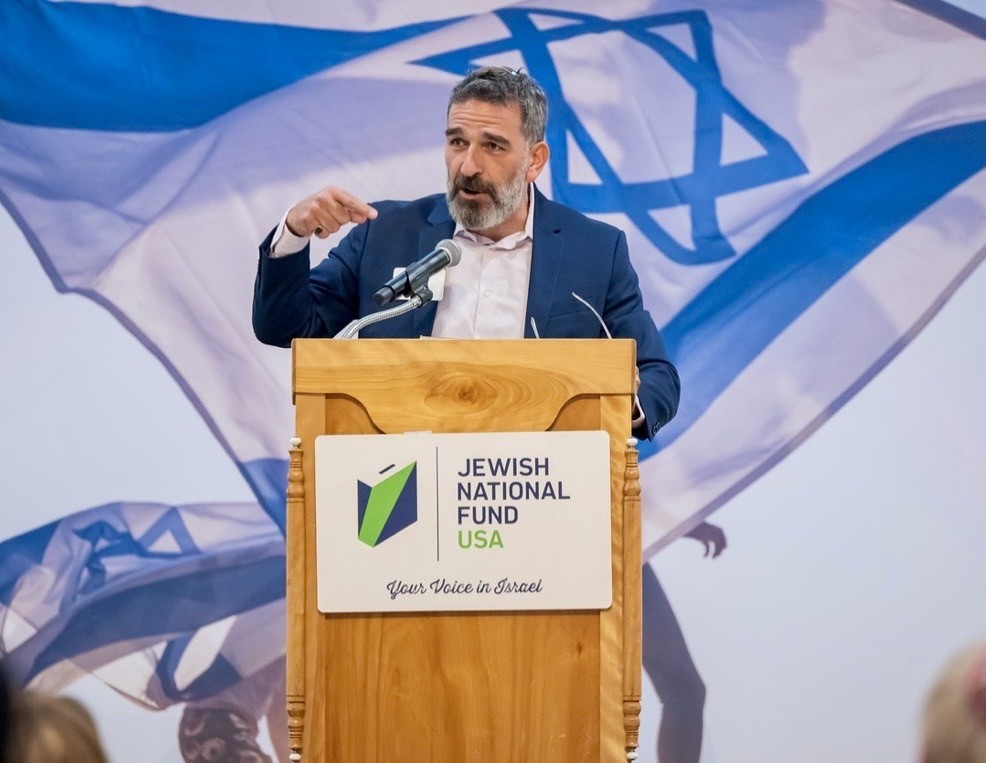
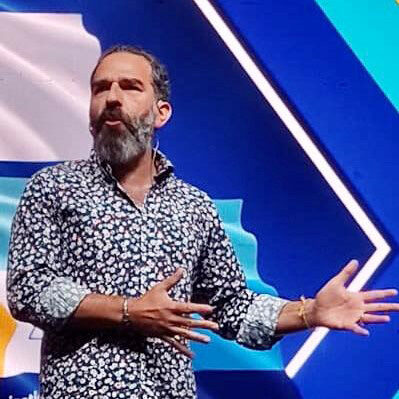
These words are from a presentation I gave at a Jewish National Fund – USA engagement in Denver, June 10, 2026 at Temple Emanuel.
I want to begin with a moment of honesty.
I travel. I speak. I meet Jewish communities across the United States and the world. And there is something extraordinarily special when walking into a room like this. A room full of people who came not because they had to, not because they were obligated to, but because they chose to be here. Because they wanted to be in this story, to be active participants in writing it, and because the future of the Jewish people, of Am Yisrael, and the State of Israel actually keeps you up at night, not only with worry and concern, but with great joy and wondrous love.
That is not nothing. In fact, I would argue it is everything.
Tonight is a celebration. And I mean that seriously, not as a social convention, but as a theological statement. To celebrate, in the Jewish tradition, is not to pretend that difficulty does not exist. It is to insist, in the face of difficulty, that what has been built matters. That what we are building matters. That joy – chosen, deliberate, communal joy – is itself an act of resistance and of faith.
So tonight I want to talk about what we are actually standing in. The inheritance we have received. The civilization we are part of. And the extraordinary, specific, joyful responsibility of being alive at this moment in Jewish history.
I want to start with a question that I find genuinely astonishing when I sit with it. How are we here?
Not rhetorically. Historically. By every law of civilizational physics, by every pattern of how peoples and cultures survive or disappear, the Jewish people should not exist. Not in any meaningful sense. Not as a living, arguing, innovating, praying, building civilization. The Pharaohs tried to break us. The Babylonians exiled us. The Romans destroyed our Temple, scattered us across continents, and erased our political sovereignty for two thousand years. The Spanish Inquisition. The Cossacks. And then – the Shoah. Six million of us, systematically murdered in the heart of modern Europe.
And yet. Here we are. In Denver. At a Jewish gathering. Talking about Israel. Celebrating Am Yisrael. Imagining our collective future.
That is not normal. That is not what usually happens to peoples who go through what we have gone through. Nations typically disappear when faced with far less. And we are not merely surviving, we are advancing. Contributing. Building. The Jewish people, numbering fewer than fifteen million worldwide, less than two tenths of one percent of humanity, have produced Einstein and Kafka and Salk and Spinoza and Freud. Have built the Middle East’s only functioning democracy. Have turned a largely barren land into a technological powerhouse that develops water solutions for drought-stricken nations, medical breakthroughs that save lives across all faiths, agricultural innovations that feed people who have never heard of Israel.
This is not a story of military might. It is a story of what happens when a people refuses to let ideas die.
I talk about “The Miracle of Persistence”, about how Am Yisrael, the Jewish people, represent something unprecedented in the human experience. Not because we are special in some abstract, self-congratulatory sense. But because the pattern of our history, the specific, documented, remarkable pattern of exile and return, destruction and rebuilding, persecution and flourishing, this pattern is the proof of something. It is evidence of a civilizational commitment so deep, so portable, so alive, that it cannot be killed by geography or power or time.
The Babylonians exiled us in 586 BCE. We could have dissolved. We didn’t. We sat by the rivers of Babylon and we wrote. We preserved. We evolved a Judaism that could exist without a Temple, without a land, without a king. We turned exile into innovation. We made portability into a theology.
The Romans destroyed the Second Temple in 70 CE. We could have disappeared. We didn’t. The rabbis of Yavneh sat down and said: we will rebuild not in stone but in text. Not in sacrifice but in study. And they produced the Mishnah, the Talmud, the entire architecture of Jewish life that carried us through the next two thousand years.
After the Shoah, the most systematic attempt at human annihilation in recorded history, we rose from the ashes and came home. And in 1948, in the same generation that survived the camps, stood tall despite being broken, and declared our national homeland – a modern sovereign state. Not because we were naive enough to think it would be easy. Because we were Jewish enough to know that the alternative was unacceptable.
That is the inheritance you are standing in tonight.
Now I want to say something about three words that every person in this room has said, has sung, has probably shouted at a rally or a concert or a Shabbat table in the last two years:
עַם יִשְׂרָאֵל חַי — Am Yisrael Chai — “The People of Israel Lives”
Those three words have been everywhere since October 7th. On signs. On t-shirts. On social media. Shouted at rallies across the world. And I don’t want to minimize that because there is real power in a people finding its voice, finding its spine, finding the words that say: we are here and we refuse to disappear.
But I want to go deeper than the slogan. Because Am Yisrael Chai is not a declaration of survival. It is a description of a way of being in the world.
Chai, the word. We wear it around our necks. We say l’chaim at every table. But do we know what it actually means? Not just “lives” in the static sense, not “exists,” not “persists,” not “is still technically present.” Chai means alive in the active, dynamic, growing, generative sense. A tree is chai when it is putting out new branches. A river is chai when it is moving. A people is chai when it is not merely enduring but producing, creating, arguing, building, teaching, dreaming.
The miracle of Jewish persistence is not that we survived. Lots of things survive. Rocks survive. Ruins survive. The miracle is that we kept being alive – in the fullest sense of that word – through every attempt to make us merely exist.
Jewish National Fund-USA has been one of the primary institutional expressions of that aliveness for 125 years.
Think about what JNF has actually done. It has planted over 250 million trees in a land that was largely deforested. It has built reservoirs and water infrastructure that turned desert into farmland. It has built parks and community spaces and schools and the physical infrastructure of a life worth living. It has taken the Jewish impulse – the ancient, persistent, almost irrational impulse to build for a future you may not live to see – and made it concrete. Literally concrete. In the ground. In the land.
That is Am Yisrael Chai as a way of life. Not a feeling. A practice.
Every tree planted was a vote for the future. Every reservoir built was an act of faith before the harvest existed.
And now – right now, in this moment – JNF is rebuilding communities in the south of Israel that the world declared finished. Communities evacuated after October 7th. Families who left everything and have been waiting to come home. JNF is not waiting for the situation to be perfect before building. JNF is building as a declaration that the situation will improve. That these families will come home. That the future is real.
That is the specific, practical, boots-on-the-ground version of Am Yisrael Chai. And every person in this room who has supported this work – who has given, who has advocated, who has come tonight – is part of it.
You are not a donor. You are a builder.
I want to give you some reasons for joy. Not manufactured reasons. Not inspirational-poster reasons. Actual, documented, real reasons for genuine, grounded, earned joy.
Israel today produces more scientific papers per capita than any other nation on earth. In a country that has been in a state of conflict for its entire existence, where every young person serves in the military, where the entire society mobilized overnight on October 7th – the universities stayed open. The labs kept running. The researchers kept publishing. Because the Jewish commitment to education and innovation is not a fair-weather commitment. It is integral to who we are.
The population of Israel is growing. The Jewish birthrate, both in Israel and in engaged diaspora communities, is strong. The next generation of Jewish leadership – in this room, in this city, across North America – is more connected, more educated about Israel, and more committed to Jewish identity than the doomsayers predicted.
October 7th did not break the next generation. It woke them up.
The communities being rebuilt in the south of Israel are not being rebuilt to what they were. They are being rebuilt even better! With better infrastructure, with more community space, with intentional design for resilience. The people who are choosing to go back are not going back despite what happened. They are going back because of what they believe – that this land is theirs, that this future is theirs, that Am Yisrael Chai means something they are willing to plant their lives in.
And Israel’s water technology – developed in that same desert where Abraham dug his wells – is now deployed in over forty countries. Israeli agricultural innovations feed people on six continents. The desalination systems that turned a water-scarce nation into a water-exporting one are now being adapted for drought-stricken regions across Africa and Asia. A nation of fifteen million people is feeding and hydrating the world.
The desert is not just blooming. It is teaching the world how to bloom.
That is the forest. That is what the Jewish people has built. That is what you are part of. Not metaphorically. The forests of Israel that JNF planted – the ones that were seeded by the donations of previous generations, by the pennies collected in little blue boxes in Jewish homes across America, by the Zionists who came before us and decided the future was worth investing in before they could see it – those trees are real. They are standing. They have been there for over 100 years, giving shade and oxygen and beauty to a land that was barren when our grandparents gave to plant them.
We are the generation that got to live under those trees.
And we are the generation that gets to plant the next ones.
Am Yisrael Chai is not a slogan about the past. It is a commitment about the future. It is the declaration that the aliveness of this people – the generative, creative, building, dreaming aliveness – will continue. Not because history guarantees it. History guarantees nothing. But because we choose it. Because we show up. Because we build. Because we come to receptions on Tuesday evenings in June and say: this story matters to me. I am a part of it, it is a part me, and I want my children to inherit something I helped build.
The ancestors who came before us did not have certainty. They had commitment. They did not know that the State would survive its first war, its second, its sixth. They did not know that the desert would bloom, that the technology would flourish, that the people scattered across the earth would come home. They just decided – with that particular Jewish combination of chutzpah and faith – that the future was worth planting for.
Now it is our turn. The question is not whether Am Yisrael Chai. It is how.
It is what we build.
It is what we leave.
It is the answer when we ask: What kind of ancestors will we be?
Am Yisrael Chai – not just a slogan, but a way of life.

Well I was one of the ‘chosen’ who made a choice last Tuesday to show up. Rabbi Sinai re-energized my soul with positivity and truth and optimism showing exactly who we are as Jews, believing in and supporting Israel our homeland.
It’s the reboot and reset I needed and I’m sharing and shouting out his brilliant and obvious statements of who we are!
Thank you!